|
1
|
- © Copyright 1978-2008, Ben Livson,
BAL Consulting P/L™. All rights reserved.
- It has yet to be proven that intelligence has any survival value.
- 2 is not equal to 3, not even for large values of 2.
Grabel's Law
|
|
2
|
- A true entrepreneur does not need capital:
- HP started with $538 in 1938, Microsoft & Apple capital was $5000 in
the 1970s
- DEC-Gen Doriot $70K 1957-> $350m 1971
- All you need is a customer
- Paul Allen on Microsoft – IBM
- Mail Order – UPS in the USA
|
|
3
|
- Liquidation value = net assets – full liabilities
- Most companies have net nil or negative value. Assets are realized at a
fraction but liabilities have to be paid out in full.
- Build your value by:
- Get investment – prove yourself to investors
- Build a track record of financial performance
- Exit by Private Trade Sale or Public Listing
- The real company value only known at exit
|
|
4
|
- Founders: keep records & ensure legal separation
- Family, Friends & Fools
- Doctors & Dentists
- Angels
- Lead Venture Capitalist
- Other VCs à due
diligence by referral
- Government Funding
- Warning: syndicate to keep no of shareholders<10
|
|
5
|
- Seed
- Startup
- Early Stage
- Expansion
- Management Buy-Out/Mature/Exit
|
|
6
|
- 20,000 enterprises
- 15,000 – 16,000 fail (75%-80% failure rate)
- 3,000 – 4,000 trade sales (15%-20%)
- 300 NASDAQ IPOs (<2% make it to IPO)
- IPO strategies
- Immediately – founders known in industry
- After proven financial performance
|
|
7
|
- The market approach – comparative – suitable when value yet another
dot.com;
- the income approach - recognizes future earnings by calculating the
present value of projected cash flows at a reasonable present value
discount rate.
- and the asset-based approach – results in the lowest valuation based on
expenditure.
|
|
8
|
- Financing Round: Seed, First, Second, Third, Mezzanine and IPO
- Pre-Money Valuation: post-money valuation of a company at a financing
round minus the amount raised at that round.
- Step-Up in Value: increase in pre-money valuation between two financing
rounds e.g. $10m/$2m = x5
- Return on Capitalization (ROC): annualized change, or growth, in
pre-money market capitalization between two rounds.
|
|
9
|
- Economic Profit = Invested Capital x (ROIC – Opportunity Cost of
Capital)
- How do you forecast ROIC when a startup has no revenue, next to nil
physical assets, good will as premium on valuation and IP?
- Partial answer: V&V measurable milestones
- Minimum ROIC for startups: 40% (30% risk of having to write-off
investment altogether)
|
|
10
|
- Granted clusters of patents in key markets may be worth millions
- 90% of NASDAQ is about true blue chips with 15+ to 100 years of proven
financial performance, years of high profitability and massive protected
intellectual property: IBM, AT&T, Cisco, Microsoft, HP, Sun ..
- Ideas are worth millions – ideas are an unpaid prerequisite – VCs invest
in implemented ideas
- NASDAQ is about dot.coms
|
|
11
|
- Cost: Provisional $2K à International Search $20K à National Granted
$30K à
Global $400K à global cluster of patents $multi-million
- IP protection is a major business function
- Patents are a CSF for many Australian success stories: Cochlear, ResMed,
Orbital Engine and Metal Storm
- Utility required but no $value is
necessary
- Watch: IP assignment to company & no sharing
- 5+ years provisional à intntl search à pending national à granted national à global cluster
|
|
12
|
- Vast differences in VC performance:
- A quarter of VCs loose their funds
- A quarter of VCs barely maintain funds
- A quarter of VCs gain commercial bank interest
- A quarter of VCs have 30%+ IRRs
- For each ten investments: 3 Dogs , 4 Walking Dead, 2 Cash Cows and 1
Home Run = the reason why you are a VC
|
|
13
|
- By Gordon Bell DEC & Heidi Mason Regis McKenna
- When you can measure what you are speaking about, and express it in numbers, you know
something about it: but when you cannot express it in numbers, your
knowledge is of a meagre and unsatisfactory kind: it may be the
beginning of knowledge, but you have scarcely, in your thoughts,
advanced to the stage of science.
- -William Thompson, Lord Kelvin 1882-1907) Popular Lectures and
Addresses, 1891-94
|
|
14
|
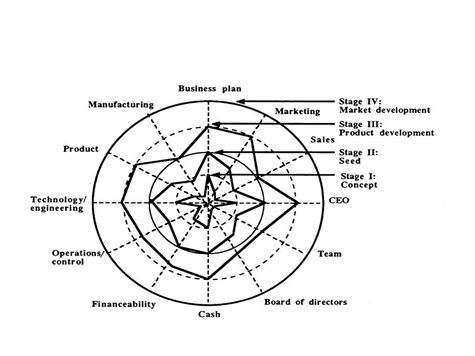
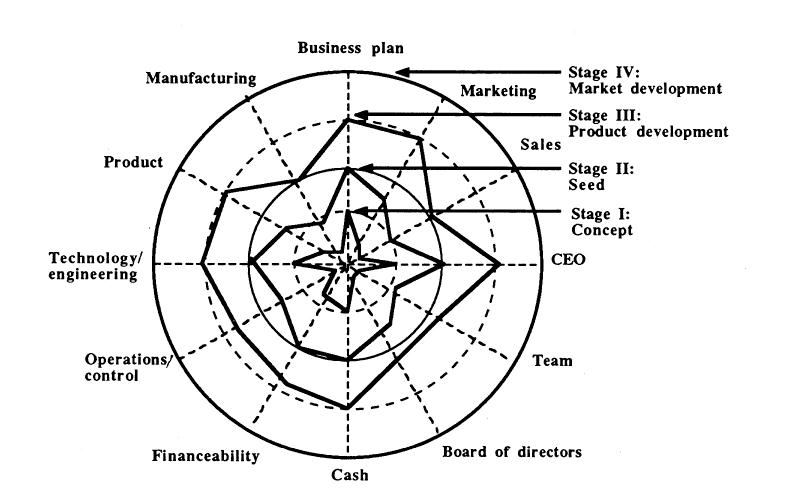
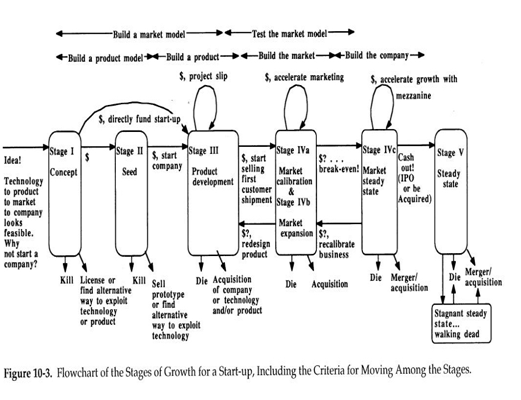
- The four major elements of the Bell-Mason Diagnostic include:
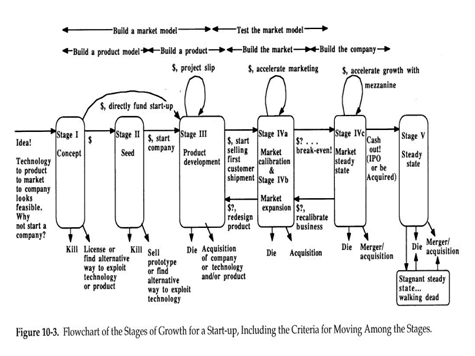
- 1. The five stages of company growth
- 2. The twelve dimensions that are measured to
assess a start-up
- 3. The rules used to evaluate each dimension
- 4. A relational graph plotted against the ideal
model for success
|
|
15
|
- The twelve dimensions are grouped into 4:
- Technology/Engineering, Manufacturing and Product
- Business plan, Marketing and Sales
- CEO, Team and Board of Directors
- Cash, Finance-ability and Operations/Control
|
|
16
|
|
|
17
|
|
|
18
|
- Approach
- Offer
- Need
- Claims
- Due Diligence
- Key Terms
- Negotiation and Deal
|
|
19
|
- Best startups are approached
- Passive 2nd Board Advertising: ASX e.m .. IPO.com
- Conferences as pickups for date
- Well promoted sophisticated web-sites
- Universal Law of <= 6 Degrees of Separation
- Do your homework: no unsolicited approaches
- More than 90% of proposals rejected on approach and many due to
primitive approach
- Thorough analysis of your investor(s) is critical before you make your
1st move
|
|
20
|
- Presentations – meet the key people
- NDA+schedule, business plan & financials
- Quality and timeliness of obtaining an up-to-date Information Memorandum
- VC’s level of good will is very high at the beginning and decreases
exponentially over time. Be prepared. You cannot buy time lost
- VCs spend >80% waiting for startups to act.
|
|
21
|
- Be specific about the need for investment
- Needs are not questioned at the beginning
- Need determines investment
- Equity = Investment/Valuation
- Lead VC equity =>25% and <=50%
- If $1m need, valuation =>$2m and <=$4m
- If justified, AusIndustry can match $ for $
|
|
22
|
- Self-critique & integrity are priceless and the only way to build a
successful business
- Never refer to a party without naming it
- VCs detest name droppers
- Never make claims that cannot be verified
- Measurable milestones -> payment schedule
- Be careful about forecasting revenue
|
|
23
|
- Referential due diligence strongly preferred
- 1st due diligence is costly & takes time
- Sloppy cooperation is a big warning sign
- DD is about people: key management and advisory group will get reference
checked
- Books are usually a no-brainer except for the color of money spent
- Expert opinion: 1 & 2 pass
|
|
24
|
- Board seats, minority protection e.g. veto
- Rights on future capital raisings
- Terms on future finance e.g. anti-dilution
- Payments driven by verifiable milestones
- Handling of undeclared liabilities
- Service contracts
- Exit mechanism
|
|
25
|
- VC’s 1st offer is always the best offer and probably the last
offer as well based on 20+ years of experience as an employee and small
business
- Negotiation must be less 3 weeks – goodwill decreases exponentially over
time
- VCs are for a WIN-WIN and have every incentive to offer you a good deal
|
|
26
|
- Everything centers around the CEO
- Wife & husband .. Bros .. business
- No hurt money – just personal time
- 70% of investment spent in 3 months
- J curve or “hockey stick” revenue forecast
- Percent of market without milestones
- No competition, no research, no disclosure
|
|
27
|
- True partnership of 3-4 founders. CEO is only the first among equals
- Coal face paid >75% of expenses
- World class advisory group
- Hurt money – extra mortgages & give up secure jobs. Startup is not a
hobby.
- True achievements e.g. US patent granted
|

 Notes
Notes