|
1
|
- © Copyright 1978-2007 Ben Livson, BAL Consulting P/L™.
All rights reserved.
|
|
2
|
- When you can measure what you are speaking about, and express it in numbers, you know
something about it: but when you cannot express it in numbers, your
knowledge is of a meagre and unsatisfactory kind: it may be the
beginning of knowledge, but you have scarcely, in your thoughts,
advanced to the stage of science.
|
|
3
|
- Human Capital: Competencies, Attitude …
- Structural Capital
- Policies, Procedures and Processes
- Corporate Databases
- Content
- Intellectual Property: Patents, Licenses …
- Customer Capital
- Marketing, Sales and Delivery Channels
- Customer Relationship
- Partnerships and Alliances
|
|
4
|
|
|
5
|
|
|
6
|
- Economic Value-Added (EVA) =
- Accounting Profit – Cost of
Shareholder Capital
|
|
7
|
|
|
8
|
|
|
9
|
|
|
10
|
|
|
11
|
|
|
12
|
- Book Value Accounting still based on Luca Pacioli’s 1494 Summa de
Arithmetica, Geometrica, Proportioni et Proportionalita treatise on
double-entry bookkeeping also known as the Italian Method.
|
|
13
|
|
|
14
|
- $People Brand Advantage
- $Process Strategic Advantage
- $Content Organizational Advantage
- $Brand Mapping of Intangibles
- $Alliances Competitive Advantage
- $Customers Risk Reduction
- $IP Intellectual Property
|
|
15
|
|
|
16
|
|
|
17
|
- Knowledge Capital = (Normalized earnings - earnings from tangible and
financial assets)/(Knowledge capital discount rate)
- Strengths: Valuation is forward looking. It has some predictive
capability.
- Weaknesses: Requires more effort to apply.
|
|
18
|
- Intellectual Capital = Market Value (Price/Share x # of shares) - Book
Value (Equity - Debt)
- Strassmann’s Knowledge Capital = (Profits - Financial Capital
"Rental")/(interest rate cost of long term debt)
- Tobin’s Q = Market Value/Replacement Cost
|
|
19
|
- Calculate average pre-tax earnings for three years
Calculate average year-end tangible assets for 3 years
Divide earnings by assets --> company average ROA for 3
years
Find industry average ROA
Multiply industry ROA by company's tangible assets. Subtract
product from
company's pre-tax earnings. --> Excess return.
Calculate 3 year average tax rate. Multiply by excess
return
Subtract from excess return --> premium attributable to
intangible assets.
Calculate Net Present Value of Premium. Divide premium by
discount rate. (i.e., cost of capital)
|
|
20
|
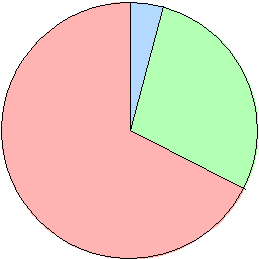
- MC=Market Capital, KC=Knowledge Capital, BV=Book Value &
CV=Comprehensive Value and PV=Perception Value in market perception
- CV=BV+KC
- MC=CV+PV=BV+KC+PV
- Nokia 2000: MC=$160b=$6b+$94b+$60b
- High PV=>Overvalued; Low PV => Undervalued
- Best Stock: Low PV and High KC !
|

 Notes
Notes